I am scared for my GPU
The things that worry me when I put load on my GPU, especially after my last experiment.
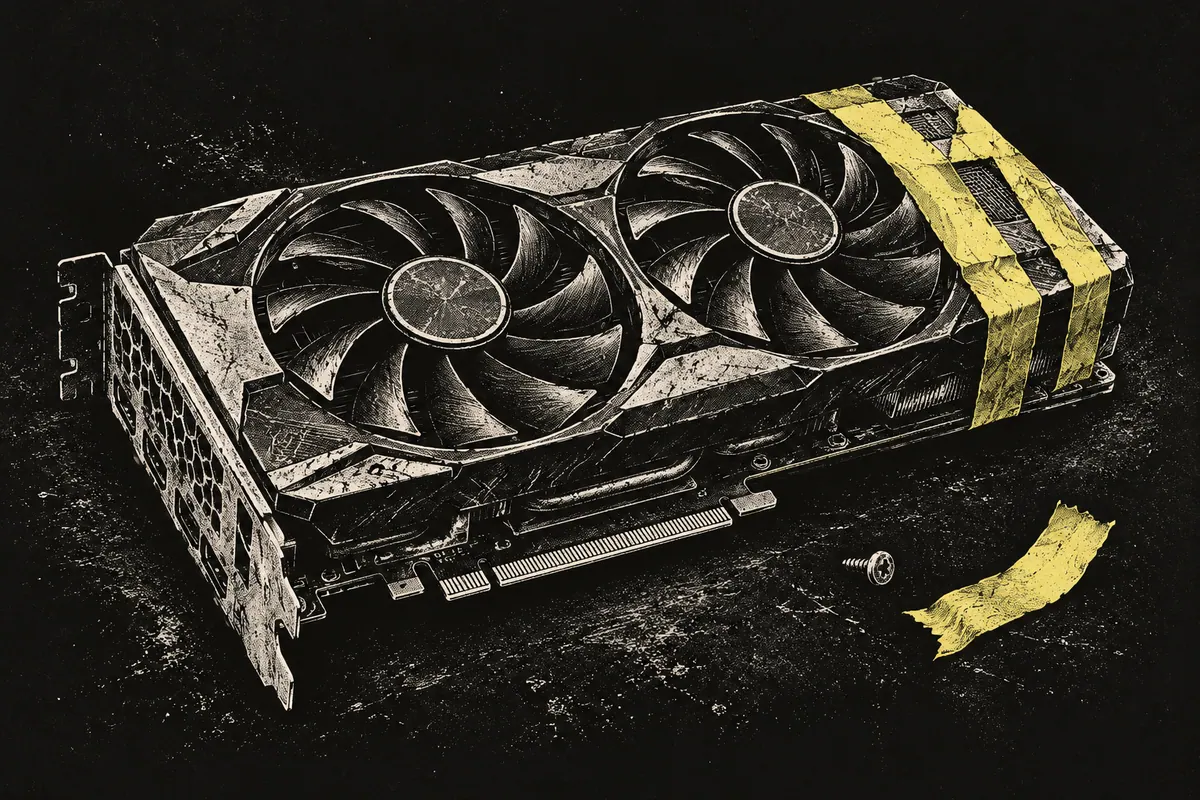
I have a modest NVidia RTX 3060Ti 8 GB card. When I purchased it, this was the most reasonable one I could get within my budget. I use it for gaming and, the running deep learning models.
A short while back, I replaced the thermal paste on my GPU but lost a couple of the tiny screws. The outer shroud closes, but it’s held on by just two screws at one end. The position of the card, when the cabinet is at its upright position felt like it could introduce a gravity-and-vibrations-induced torque. That could cause the shroud to hang ever-so-lightly from one end, thereby reducing pressure and disturbing the orientation of the heat fins. All of these could lead to the card heating up faster than normal and, with the fans kicking in, extra vibration from their motion could loosen the handing end! Result? Degraded GPU performance and a potential crash and hazard when I least expect it.
What did I do? After overthinking and playing crash scenarios in my mind, I settled for duct tape - rather, the electric tape. Well, zip ties would have been better, in hindsight but, I didn’t have any at hand. I wrapped around cris-crossing layers of tape on the end of the side that had missing screws, careful to make sure none of it goes near the fans. Don’t want tape wrapping around a fan now, do we? It looks messy - GPU with tape but, then, I started overthinking again. I felt like I had solved one problem but introduced another.
See, the adhesive in the tape can react based on temperature - although electric tape should hold and its on plastic so it shouldn’t feel the direct heat from the die. But still, what if constant high temperatures dry it out? Well, I settled for running it at lower than optimal settings. I brought down the temperature limit from 83 to 75 degrees Celsius and the power limit to 150 Watts in LACT. That helps keep it stable during constant loads like gaming or videos.
But running models turned out to be a different ball game altogether. Depending on the task - inference or training - temperatures at certain batches could peak and hold over 75 before LACT’s software temperature cap kicked in. This would make the GPU reduce its clock speed to come under 75 then, boost up again which could lead to another spike and another throttle. If you measure it out, the average temperature stays around that 75 degrees limit while the GPU undergoes constant throttles. Also, I don’t like these sudden high spikes - I am paranoid it’ll mess up the tape.
So for now, whenever I run inference or training, I add temperature management in the harness. It basically monitors the temperature reported by nvidia-ml and when it crosses
a limit, it pauses the active work on the GPU until the temperature falls below a threshold. This helps throttle the GPU less often and keep the working temperature of the card
much more under the limit. But yes, it increases the processing time. I am planning to benchmark it over a weekend to see if the differences are really noticeable and whether
the additional time penalty is worth it. More to come on this when I have numbers!